


Companion Planting with Flowers for Pest Control
- May 6, 2023
- 7 min read
Updated: May 30, 2023
I have long been an organic gardener, since the early days when 'green' was simply a colour, using companion planting to grow bigger, better, healthier and happier edibles. Companion planting is just part of organic gardening, but a very important part.

Why adding flowers to your vegetable garden is a Big Deal?
Annuals are very beneficial companion plants for your garden. They deter bad bugs, attract good bugs, feed pollinators, and/or work as lure plants. Their pollen, nectar, and seeds bring hummingbirds, butterflies, and birds to your garden for pest control and pollination.
Flowers make your plants thrive and may even make your vegetables taste better .. Plus, add beauty, colour and fragrance to your garden, while being inexpensive and so much easier (earth friendlier) than sprays or tonics.
At my wee greenhouse, I sold flats of flowers designed for the vegetable garden to feed pollinators and attract beneficials. Here are the top 3 flowers that were always in those packs.

Top 3 Annuals That No Organic Vegetable Bed Should Be Without...
1. Marigolds - The marigold is the most common of flowers and yet is the workhorse of the companion garden. Plant marigolds everywhere in your vegetable garden, especially around your tomatoes, peppers, squash, and cucumbers. There is no fruit or vegetable that will not flourish with a marigold growing beside it.
Marigolds deter aphids, nematodes (small worms in the soil), beetles, and maggots. They also encourage better growth in your edibles, likely because both the roots and the foliage are safe from nearly all pests! They also draw in the beneficial insects that control the bad bugs. French marigolds are also effective at controlling the bad root nematodes that cause club root and other garden soil diseases.

French marigolds are bushy, stay short and tight, making for a really nice border plant or colourful mini hedge. I tend to use mostly red or orange varieties, as I am not a huge fan of yellow in my summer garden. The Bonanza, Disco, and Duranga series of marigolds are my faves, I especially love Red Disco. You want to get a simple, open-faced marigold rather than a fluffy, double petalled one, as they have more nectar and pollen for the pollinators.
Though, must admit that I also really love the heirloom varieties of marigolds, like Jester or Harlequin (see picture above), that grow 2 to 3 feet tall and sprawl madly, spilling over the beds into the pathways. Something about happy, thriving plants, spilling and tumbling all over, that makes me super happy.

Gem tagetes (aka signets) are also marigolds. They have lovely ferny foliage and single blossoms in burnt red, tangerine, or lemon yellow (as in the picture). The plant looks very delicate but is an amazing workhorse in the greenhouse or garden beds to repel tomato hornworm, nematodes, whitefly, and other garden pests.

2. Sweet Alyssum - Is a draw for hoverflies, parasitoids, and ladybugs. These beneficial insects eat aphids and caterpillars, plus the eggs of many of your most annoying garden pests. Their sweet scent adds perfume to the garden while the pollen attracts pollinators to keep your garden growing and producing.
Alyssum sometimes self seeds so will come back year after year, is dainty and attractive in the garden. Plant it in all the bare spots in and around your garden to prevent weeds. It thrives in the heat as long as watered well, breaks up soil, and spreads readily. Has medicinal and protective uses, too.
White alyssum is the hardiest and the most attractive to the beneficial insects while the bees like the pale purple hues best.

3. Calendula - Useful everywhere and for everything, just like the marigold. Is more effective than both alyssum and marigolds at attracting beneficial insects whose larvae eat the bad bugs and their eggs. Bonus is that it self seeds readily so you usually only have to buy it once and then can transplant it from your garden to wherever you need it. I love growing marigolds in summer, but I let the calendula go like mad in spring and fall, as they thrive in cool temps while the marigolds do not. The petals are also useful additions to ointments, oils, soaps, and shampoos.

Calendula is usually sold in bright yellows and oranges but there is also a beautiful pink one available called Strawberry Blonde. While you will not find it at your local greenhouse, it is super easy to grow from seed. Direct sow or prestart. Super easy and cool weather hardy. Oh, and the flowers close at night or on rainy days, are open in sunshine.
Those are the three most important companion plants and should be scattered throughout your garden with carefree abandon. If you only buy tons of these three flowers, you will have a virtually pest free food and flower garden!
More Flowers That Work Hard In Your Garden

Plant whatever flowers you like, perennial or annual, as it is sure to attract some beneficial insect to your garden, whether a pollinator or a pest annihilator.
Here are more ideas your organic gardening needs, in order of importance and efficacy.
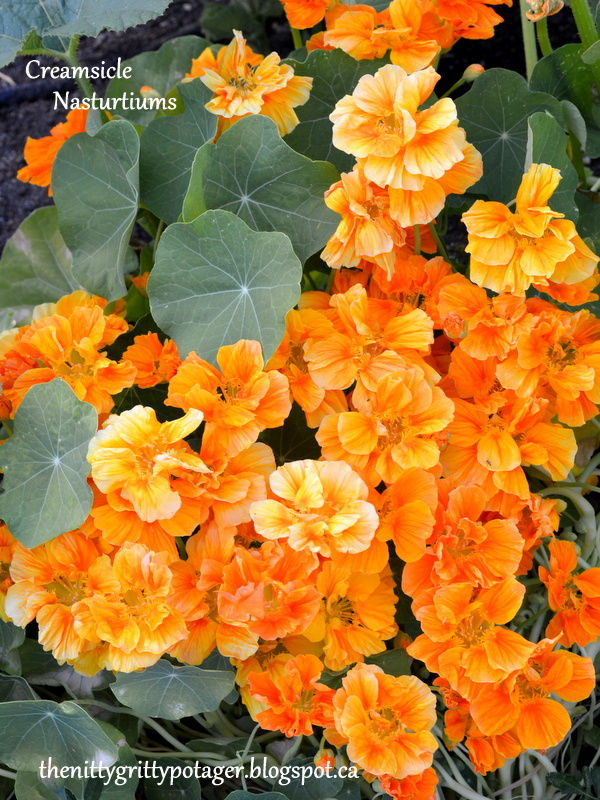
4. Nasturtiums - Nasturtiums are great companion plants to grow near your radishes, cucumbers, melons, and the entire brassica family. Tomatoes, too, if you have room, but my tomatoes are always surrounded by marigolds, parsley and basil ; )
They deter aphids, potato bugs and squash bugs, white flies (esp in the greenhouse), and cucumber beetles but are also often used as a trap crop for black aphids, drawing the bugs to them instead of to the vegetables.
The flowers are super tasty in salads, have a nice, light, peppery flavour, while the seeds can be pickled and used as capers.

Nasturtium's come in great range of hues, from soft pastels to vibrant and popping colours. Bright or soft yellows, oranges like the Creamsicle above, creamy whites, burnished reds, bright reds... Cherries Jubilee is my absolute favourite! I mostly grow the clumping varieties as I like them spilling over the sides of my raised beds, but there are also trailing varieties that are perfect for baskets, trellises, or sprawling through your beds.

5. Zinnia's - Zinnia's are, bar-none, my very favourite veggie garden additions! They are late summer bloomers and so add colour to the garden as others start to peter off. They come in a huge array of sizes, shapes and colours and are rarely bothered by pests or diseases. Is my favourite go to flower.
They bring in butterflies, hummingbirds, and bees, deter both tomato worms and cucumber beetles, attract hoverflies and other beneficial insects, especially helpful at the end of summer while the aphids start to attack your cabbages and kale. Plant loads of zinnias.

6. Geraniums - Plant near grape vines, roses, cabbage, corn and beets to lure away pests and to repel caterpillars! They add colour and fragrance to your garden and the foliage of the scented ones can be used for cooking and baking. They also are known to repel spider mites, so plant one or place a potted one by affected plants. I have a love affair with geraniums, they have always been my favourite for pots, planters and baskets.

7. Sunflowers - One of the best pollinator feeding flowers you can grow! Bees just love them. Plant by corn to lure away aphids. The ants and the aphids can crawl around on the sunflower and cause no real damage to the flowers. Plant by cucumbers to enhance the flavour and as a support for the cukes to climb up. I have been told that if you grow your pole beans up and around sunflowers, they will stunt the growth of the bean but promote earlier production by a few weeks. Therefore, in my opinion, is well worth your while to plant a few beans to climb up your sunflowers for the earlier harvest, while you wait for your main crop to come through.

There are all kinds of additional flowers that will also repel bad bugs, attract good bugs, draw in pollinators, or butterflies, and birds.
If you plant it, they will come.

The more flower varieties you add to your garden, the healthier your garden will be. A garden full of birds that eat bugs, bees that pollinate, and good bugs that eat bad bugs, is free of pest and disease, plus loaded with flourishing edibles.
Additional annuals and perennials to consider ... sweet peas, dianthus, Queen Anne's Lace, snapdragons, pansies, violas, Johnny Jump-ups. nicotiana, single dahlias, and yarrow.
Flowers are the healthiest best way to have a pest free garden, I say they are the only way. They work! If you see aphids on a veggie or flower, walk away and leave it be for a day or two, the beneficial insects and their larvae will come along and have a feast. Attract the good bugs to your garden with flowers and they will stay for the bugs (and the pollen).
Sprays are all non-discriminating, even the organic ones and the diy ones, so if you spray even once, you will need to keep spraying for the rest of the summer as you have just killed off all the beneficial insects, their larvae and eggs that were sitting there in your garden, ready and willing to eat your bad bugs.
Start a movement, grow with flowers, your garden will thank you for it with great bounty.
There are only two rules when it comes to planting for the pollinators and good bugs.

1. KISS - Keep it simple, silly! The more simple the flower, the more attractive it is to both bees and beneficials. There is more food in a simple, open faced flowers than in the new hybridized flowers that are so fancy and pretty, that we love so much. Think daisy shaped for lots of food.
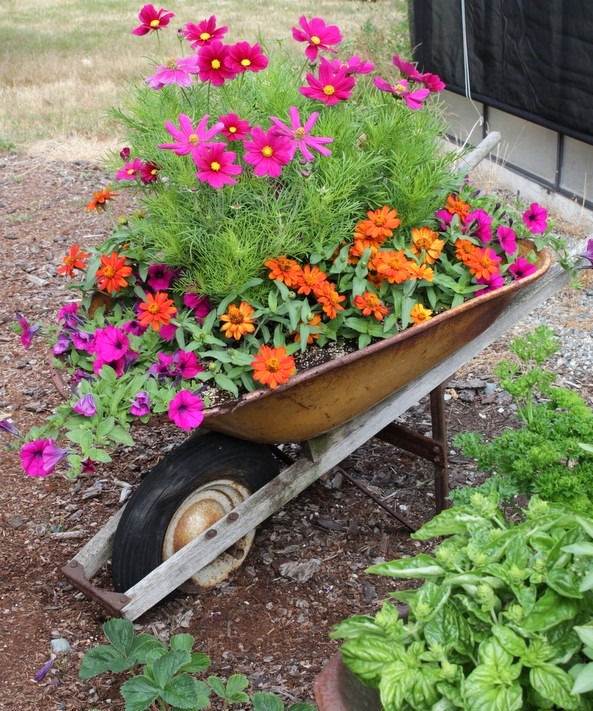
2. Plant in blocks or in rows for the beneficial insects to stay in your garden and lay their eggs. The parasitoids and hoverflies will land on your flowers 3 times. If they land on the same flower each time they land, they will feel that this is a good place for their babies to grow up as there is enough food for them. If they land on a different flower each time, they will move on.
So, I like to plant my cosmos and zinnias in big blocks, sunflowers in blocks or rows, and the others are always planted in rows between each variety of veggie (as a divider almost), or in long rows as a border plant, all around the sides of the raised beds or gardens.

Herbs and their flowers are also very important companion plants ... borage, basil, chives, parsley, rosemary, chamomile, tansy, feverfew, dill, cilantro, oregano, and thyme.
There is a saying the goes like this...
Bees love to forage for borage. Borage is the flower in the garden bed above. It gets tall and big, full of gorgeous blue blossoms, self seeds readily, and it is a bee magnet.
If you are wanting better pollination in your greenhouse, tomatoes, cucumbers, squash... just pop in some borage. They will find it. Borage is also a great companion for strawberries and it deposits minerals into the ground that make them grow better. Put the clippings in your compost bin for those added minerals, too.


Comments